

The adoption of the public cloud is not only changing how IT consumes technology, but it’s reshaping how businesses think about real estate. Or at least—it should be.
One of the most visible impacts of cloud services has been on commercial real estate, especially the space once dedicated to data centers. With more organizations moving their infrastructure to colocation facilities or public cloud platforms like AWS, the physical footprint required for hardware has shrunk dramatically.
The next wave of change affects the floor space once filled with cubicles. Thanks to mobile, wireless, and cloud-enabled tools, employees are no longer confined to desks. This virtualization of the traditional office reflects the same shift we see in IT: increased flexibility, scalability, and cost efficiency.
Our team knows this first-hand.
As a solution provider rooted in the cloud, we’ve had access to all the collaboration, mobility, and CloudOps tools a business could want. Yet, like many startups, we began our journey in cafes—Wegman’s and Panera were our early HQs.
Our first office space was fairly standard: private offices, conference rooms, and rows of cubes. But something interesting happened. Despite the setup, our team instinctively gathered in one large conference room. Tethered desks couldn’t compete with the power of in-person collaboration.
When we outgrew that space, we moved to an office that favored openness over partitions. We placed desks in a large open area and saw even more collaboration. With tools like the WebEx Board and access to managed cloud services for life sciences, our teams could easily toggle between digital meetings and spontaneous brainstorming.
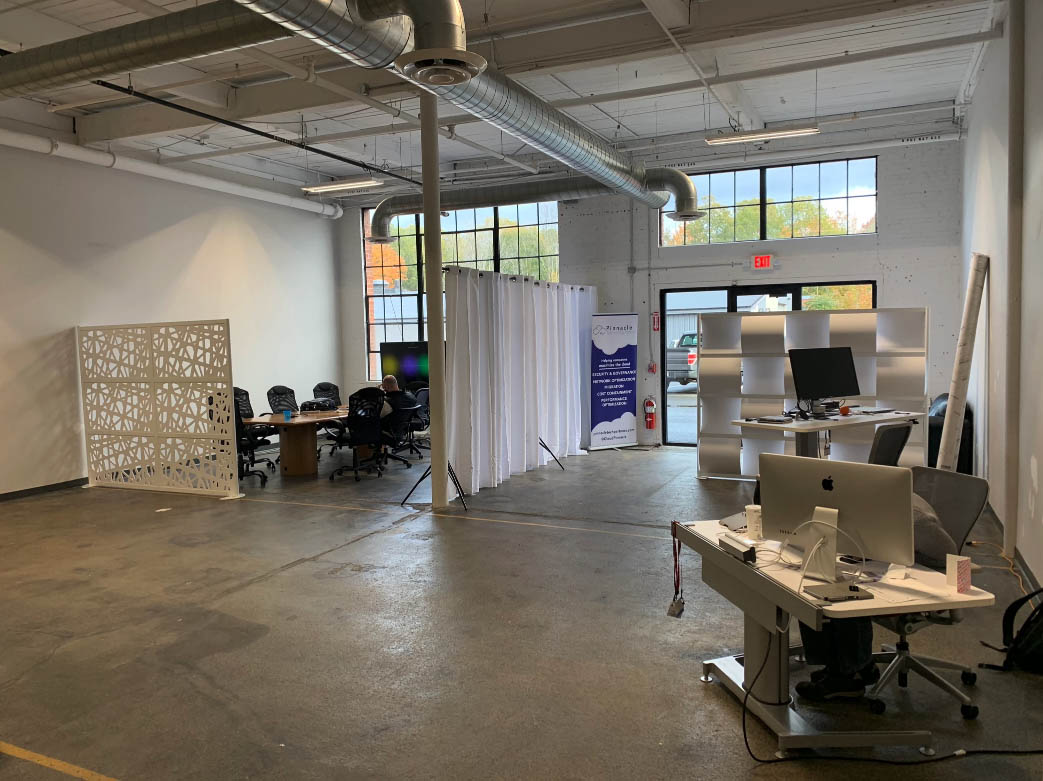
This summer, when the chance came to develop a new space, we went all in on flexibility—the same philosophy that underpins modern cloud architecture. We found a renovated mill designed for creative and tech communities. With everything from shared conference rooms to breweries under one roof, the space could scale as we grew, while still supporting a strong, connected culture.
We built an open layout using stand-up desks and movable dividers, allowing teams to customize workspaces on demand. This approach not only encouraged creativity—it let us reduce our footprint while improving collaboration and employee satisfaction.
It’s wild to see so many companies still investing heavily in traditional office layouts. To me, that’s like building out an on-prem data center in 2025. It doesn’t match how IT—or people—work today.
Whether it’s supporting biotech startups, scaling cloud infrastructure for clinical research, or enhancing scientific computing IT support, the lessons we’ve learned about workspace evolution are the same as those we apply in IT: stay agile, stay scalable, and design for how people really work.
 About PTP
PTP is a leading IT provider for life sciences companies, delivering secure, scalable, and compliant technology solutions for biotech, clinical research, and healthcare organizations. As an AWS Advanced Tier Consulting Partner with the Life Sciences Competency, PTP specializes in managed IT services for life sciences, including cloud migration, FinOps, DevOps, cybersecurity, and managed cloud services for life sciences.
Through its PeakPlus™ platform, PTP offers comprehensive biotech IT support and life sciences IT support tailored to genomics, data science, and regulated research environments—supporting everything from HIPAA and GxP compliance to IT infrastructure for biotech startups and clinical trials. Based in Boston, PTP helps the world’s most innovative life sciences companies reduce costs, meet compliance goals, and accelerate discovery.
Media Contact:
Gary Derheim
VP, Marketing & Business Development
marketing@ptp.cloud